
Indian Space-Tech Startup Pixxel Raises $100 Million in Record Funding Round
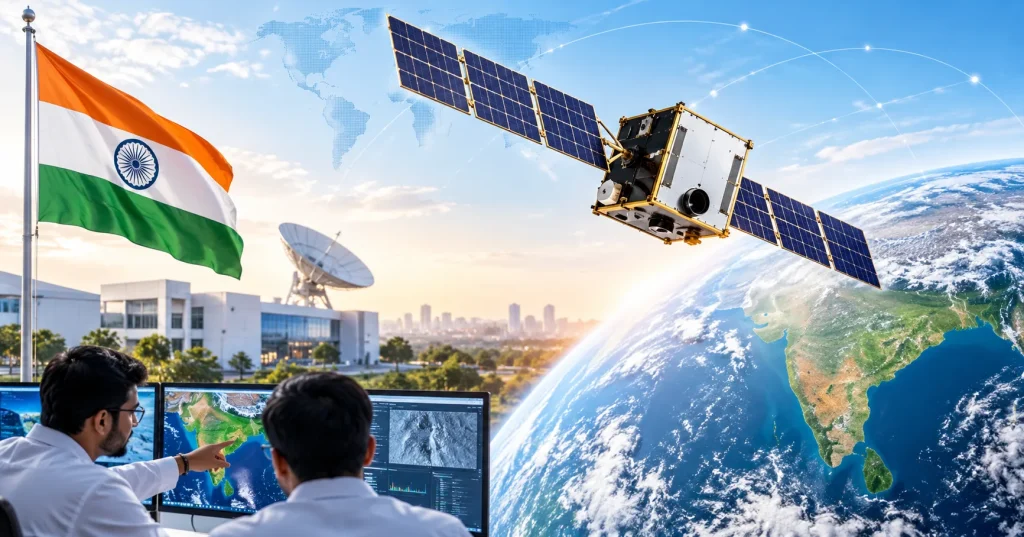
India’s private space sector has reached another major milestone, with Bengaluru-based space technology company Pixxel raising $100 million in Series C funding.
The round was co-led by Singapore investment company Temasek and specialist space investor Seraphim, with participation from new and existing investors. The latest investment brings Pixxel’s total funding to approximately $195 million and has been described as the largest funding round secured by an Indian space-technology company to date.
For a company that began with the idea of using satellites to understand the Earth in greater detail, the new funding represents a significant step towards a much broader ambition.
From hyperspectral satellites to planetary intelligence
Pixxel initially became known for its work in hyperspectral Earth observation.
Unlike conventional satellite cameras that capture information across a few broad colour bands, hyperspectral sensors can analyse hundreds of narrow wavelengths. This allows them to detect information about crops, soil, water, minerals, pollution and other environmental conditions that may not be visible in ordinary satellite images.
Pixxel now operates six Firefly hyperspectral satellites and has also developed Aurora, its Earth-intelligence software platform.
The company’s longer-term goal is no longer limited to taking satellite images. It wants to create what it describes as planetary infrastructure — combining different satellite sensors, software and space systems to help governments and businesses understand changes taking place on Earth.
Where will the $100 million be used?
The new investment will support several areas of expansion.
Pixxel plans to develop its next-generation Honeybee satellite constellation, including additional sensing capabilities such as shortwave infrared imaging.
It is also planning to expand into technologies including synthetic aperture radar and ultra-high-resolution optical imaging. The first Honeybee satellite is currently expected to launch in 2027.
At the same time, Pixxel intends to continue developing Aurora so data collected from different satellites can be combined and converted into information that organisations can use more easily.
Manufacturing capacity in both India and the United States is also expected to increase as the company prepares to produce more advanced satellites.
Why Pixxel matters for India
Pixxel’s funding comes during a period of rapid change in India’s space industry.
For decades, India’s space programme was dominated almost entirely by government organisations. Policy reforms have since opened more of the sector to private companies, creating opportunities for startups working in launch technology, satellites, Earth observation, communications and space-based data.
Pixxel is one of the most prominent companies to emerge from that shift. Reuters notes that the company grew after India opened the sector more widely to private participation.
The company has already secured work involving organisations including NASA and the US National Reconnaissance Office, while also participating in Indian defence and public-private space programmes.
That makes this funding round important beyond Pixxel itself.
It demonstrates that international investors are increasingly willing to place significant capital behind Indian companies developing sophisticated space technology.
Space data could become increasingly valuable
Earth-observation technology is becoming important across industries that extend far beyond traditional space research.
Satellite intelligence can potentially help with:
- monitoring crop and soil health
- detecting environmental changes
- tracking infrastructure
- managing natural resources
- identifying industrial pollution
- improving disaster response
- supporting national security
- monitoring climate-related changes
This is why companies such as Pixxel increasingly describe themselves not simply as satellite manufacturers, but as information and intelligence businesses.
The satellite may collect the data, but the real commercial value lies in turning that data into useful decisions.
A bigger ambition for Indian space technology
Pixxel was founded by Awais Ahmed and Kshitij Khandelwal while they were students, with an early vision of creating something resembling a health-monitoring system for the planet.
Seven years later, the company is raising nine-figure investment rounds and developing satellites, software and sovereign space systems.
The $100 million investment therefore marks more than another startup funding announcement.
It signals how quickly India’s private space ecosystem is moving from experimentation towards commercially significant global infrastructure.
For Pixxel, the next challenge will be turning that capital into a larger constellation, stronger software and reliable intelligence that governments and industries can use at scale.
For India, the bigger story may be that its next generation of globally recognised space companies is beginning to emerge alongside ISRO rather than solely from within it. 🚀
Source: Pixxel official announcement, Reuters and supporting industry reports.